
The six-port charger that cleared out the carry-on tangle
The running joke on London to Đà Nẵng flights is that I always pack the same bag. Laptop. iPad. Phone. AirPods. A portable speaker for the hotel. Kindle. Sometimes a camera. At the other end, every single one needs to be plugged in by 8am local time for whatever call is already booked. In my old carry-on there were four separate chargers, three USB-C cables, one Lightning cable that shouldn't have still existed, and an extension lead because most hotels have exactly one accessible outlet near the desk.
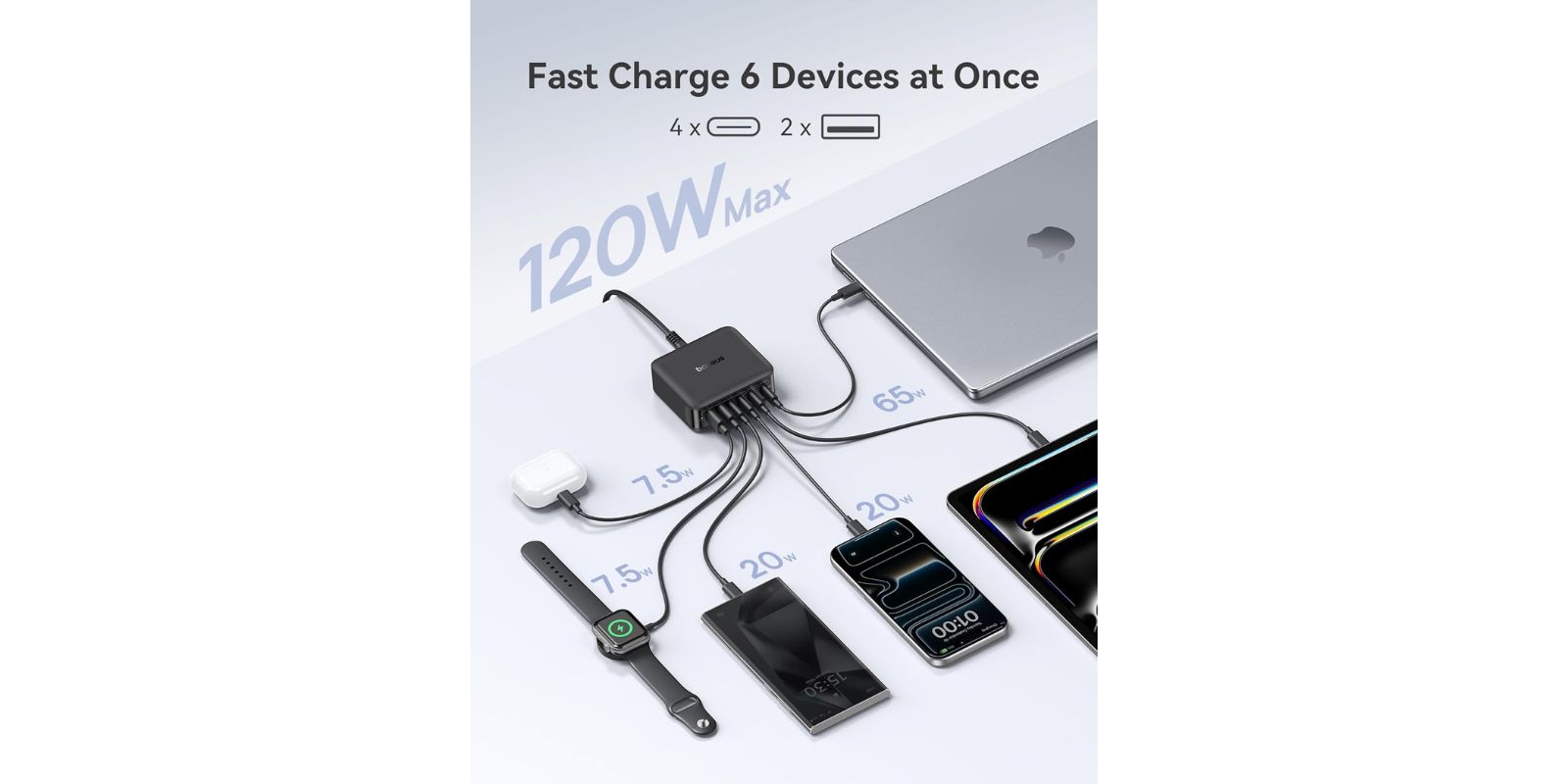
The Baseus 120W 6-in-1 charging station replaced most of that. It's a small black brick with six ports (four USB-C, two USB-A), a built-in five-foot extension cord, and a GaN chipset that keeps the whole thing about the size of two stacked iPhone boxes. One plug into the wall. Up to six devices at once.
I've been carrying it in my backpack for five months. It has outlasted the AirPods case that arrived the same week.
Who Actually Needs This
Not everyone. If you have a single laptop and a phone and that's the extent of your device life, a wall charger with two ports is enough. This is for people who have too many things to charge at once and usually one outlet to do it from.
- ✈️ You travel with more than three rechargeable devices and live in hotels with one desk outlet
- 💻 Your desk setup at home has a laptop, phone, watch, headphones, and a tablet all needing power at different points of the day
- 🪑 You work from a café or a coworking space and the nearest outlet is always five feet too far
- 🎒 You share a plug with a partner on trips and keep tripping over whose cable is whose
- 🔌 You've been accumulating wall chargers for five years and want to retire half of them
What It Gets You
120 watts total, 65 watts on one port
Enough to fast-charge a MacBook Air (roughly 30 minutes to 50%, 110 minutes to full) on the top USB-C port while the other five ports handle everything else. If you have a MacBook Pro that wants 96 or 100 watts, this will charge it, just not at full tilt. For an M4 Air or a Windows laptop under 70 watts, it's genuine fast charging. The single-port 65W figure is the one to pay attention to when you're picking a charger for a specific laptop.
A built-in extension cord
Five feet. This is the feature that sold it to me over the alternatives. Hotel desks in Europe and Southeast Asia are always arranged such that the outlet is either behind a bolted-down cabinet or under the bed. The extension cord means I plug the brick in once and the brick sits on the desk where I can reach all six ports. No separate power strip, no tangle.
GaN, so it stays cool enough
Gallium nitride means the charger is smaller and runs cooler than the same wattage from a silicon charger would. Baseus quotes 90% energy conversion, which is the marketing way of saying it wastes less heat. In practice the brick gets warm under full load (charging a laptop and two phones at once) but not hot. A few reviewers say "it does get very hot", and at the extremes of load I can see that, but in normal mixed-device use it's been fine.
Size and weight
About 77 by 84 millimeters. Less than half a kilo. Smaller than the MacBook charger I used to carry, and that charger had one port. It fits in the front pocket of my backpack next to the passport holder and I forget it's there.
💡 Tien's Note
If you have a recent Samsung phone and rely on Samsung's 45W Super Fast Charging 2.0, this one caps at about 34 watts rather than the full 45. One reviewer tested it specifically and got the same result I did. For iPhones, iPads, MacBooks, and most other USB-C devices it delivers the full rated speed, but Samsung's proprietary protocol is the one asterisk. If you're a Samsung user chasing peak charge times, look for a charger that specifically lists Samsung 2.0 support.
The Honest Version
4.7 stars across 108 reviews. 87% five-star, 2% one-star. The product is recent enough that the review count is modest, but the distribution is strong. Reviewers consistently flag the same positives: the extension cord, the compact size, the silent operation (no fan, no coil whine), and the ability to charge six devices at once from one outlet.
A few things to know before buying.
First, long-term reliability on the ports. One reviewer had two of the six ports stop working after a few weeks. Baseus replaced the unit for free and customer service came out of the exchange well. But two ports failing on a single unit is still two ports failing, and it's worth being aware of. If yours develops an issue, the warranty seems to be honored without drama.
Second, the Samsung caveat from the note above. This is the specific case where the charger under-delivers versus its full rated wattage. On every other device I've tested it on, it hits the advertised numbers.
Third, this is not an international travel adapter, it's a US plug. If you fly between London and Đà Nẵng you still need a physical plug adapter on one end. The charger itself handles 100 to 240 volts so you don't need a voltage converter, just a plug shape adapter. Worth mentioning because the marketing copy leans heavily on "travel power strip" and some buyers expect more than one plug shape in the box.
Closing
The carry-on is lighter and the tangle at the hotel desk is gone. The lost-charger count for the last five months is zero. For a piece of kit that costs less than a single day of most hotel rooms on this route, the math is easy. If you travel with enough devices that you've started rationing outlets, this is the one.
As Amazon Associates we earn from qualifying purchases. This comes at no extra cost to you.